Family Dynamics

Care cannot be provided to patients in any setting without considering the in the context of their family. As a means of developing a therapeutic relationship with a patient’s family, critical care nurses must be self-aware, look beyond the surface of the patient and families and practice with an approach of inquiry. Wright and Leahy (2009) suggest that families that would benefit most from a more detailed family assessment include those who are experiencing emotional, physical or spiritual suffering or disruption caused by a family crisis. Using the Calgary Family Assessment Model (CFAM), a relational strengths focused practice model; is one method of performing this type of assessment. See the image below for an overview of the model.
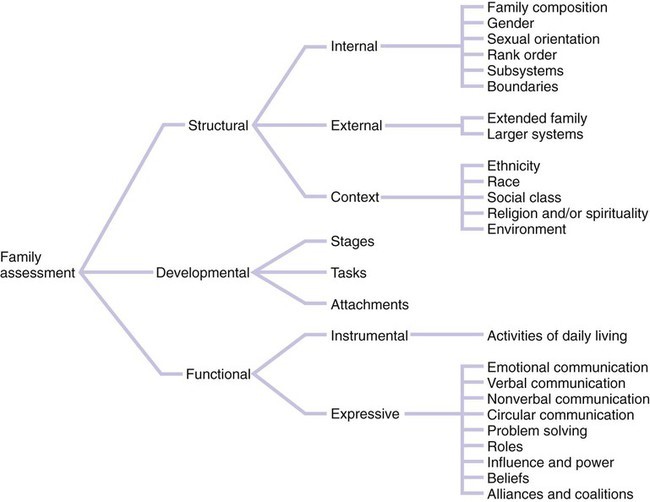

As a mechanism of developing a therapeutic relationship with family members, critical care nurses draw on the assessment and intervention processes described by Doane and Varcoe (2005) that has been adapted and is presented in the slideshow.

Entering Into Relation

Getting ”in sync” with a family

  • Conscious participation—walking alongside the family
  • Stopping to look, listen, and hear
  • Unconditional positive regard
  • Being in sync
Being in Collaborative Relation

Staying “in Sync”

  • Family and nurse working together to assess and intervene
Inquiring Into the Family Health and Healing Experience
  • Inquiry into what is meaningful to the family
  • Keeping family at the centre of the view
Following the Lead of Families
  • Taking cues from families
  • Taking a stance of curiosity, unknowing and uncertainty
  • Using theoretical knowledge to enhance sensitivity to family experience
  • Scrutinizing theoretical and expert knowledge against family experience
Listening to and for:
  • Listening through phenomenological, critical, spiritual and socioenvironmental health-promotion lenses
Self-Observation
  • Participating consciously and intentionally
  • Self-knowing
Letting Be and Change
  • Letting be to know who this family is and what is happening for them
  • Creating the opportunity for family to come to know more about their own experience, patterns, capacities, challenges and contextual constraints
Collaborative Knowledge Development

Drawing on family knowledge

  • Experiential
  • historical
  • sociocultural

Drawing on nursing knowledge

  • Scientific
  • Theoretical
  • Biomedical
  • Political
  • Practical
Pattern Recognition
  • Identifying underlying patterns of experience and responses
  • Identifying patterns of capacity and capacity-adversity
Naming and Supporting Capacity
  • Seeing and recognizing strengths
  • Looking beyond the surface
  • Honouring the family’s version of the story
  • Working with the family to enhance capacity and address adversity
Emancipatory Action
  • Recognizing and naming inequities and structural conditions
  • Drawing on and sharing contextual knowledge
  • Introducing alternative discourses
  • Devoting energy to remedying structural inequities and creating coalitions

As you read through consider the different types of families you’ve worked with already in your career and reflect on how you’ve implemented these actions previously; what worked well and how things could be improved next time.